
On this page we are going to discuss two key behaviours for people struggling with social anxiety: avoidance and safety behaviours.
They are both part of the process that keeps social anxiety going – see our page on the social anxiety maintenance cycle.
For information on situational avoidance (including a worksheet to help you list situations you avoid) – see our page avoidance.
Safety Behaviours
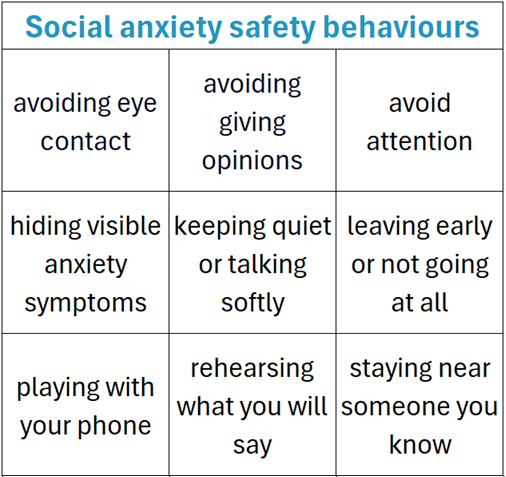 Sometimes you may not be able to avoid the situations that cause you social anxiety. To manage anxiety-provoking situations you might engage in what are called “safety behaviours”. Some may be overt (noticeable to others) such as keeping quiet, avoiding eye contact or looking at your phone. Others may be things you do in your mind – like planning out what to say or having excuses ready to leave. Different people may use different safety behaviours to help them cope.
Here is a longer list of potential safety behaviours:
• avoid speaking about yourself
• avoiding eye contact
• avoiding giving opinions
• avoid attention
• being monotone or unanimated when speaking
• finding a task or fiddling with things to look busy
• going out at the quietest times of day/night
• having an excuse ready to leave
• hiding visible signs of anxiety (sweating, blushing, trembling)
• joking or playing the fool
• keeping quiet, talking softly or just giving short answers
• people pleasing
• playing with your phone
• rehearsing words or sentences before you speak them
• staying close to someone you know
• staying on the edges of a group
• sticking to safe subjects (like work)
• talking too much or too fast
• using alcohol or recreational drugs
there are many others too….
Safety behaviours may feel like they are helping, but much like avoidance, they only give short term relief. There are usually unintended longer term consequences including:
- They reinforce the idea that social situations are dangerous
- They can backfire, for example, avoiding eye contact or being quiet might actually draw attention or make others think you are unfriendly
- You may come to rely on them – or believe it is only the safety behaviour that got you through (reinforcing the need for even more safety behaviours)
- They make you focus more on yourself causing even more anxiety (sometimes called inward focus or a feedback loop)
- They may stop you “pushing your boundaries” or trying new and more helpful ways to cope
How to reduce safety behaviours
Firstly, you need to identify your own safety behaviours which may differ depending on the situation. Try using the My Safety behaviours Worksheet.
When you are more fully aware of what your safety behaviours are, you are in a better place to consider how to reduce them. This can be hard at first, as you may have come to depend on your safety behaviours to manage your anxiety.
One of the evidence-based techniques of reducing reliance on safety behaviours is through behavioural experiments. In this technique you identify a particular safety behaviour and gradually reduce or challenge it through achievable real-world experiments.
For example – if your safety behaviour is to avoid talking about yourself (because it makes you feel self-conscious or you assume the other person wouldn’t be interested) you might deliberately test this out. Perhaps you might share what you are doing at the weekend – or what you watched on TV last night. Did the other person show interest? What did you learn and how can you get better at speaking about yourself and your interests?
If a safety behaviour is to avoid eye contact, you might start with just a few seconds eye contact and building it up more as it becomes more comfortable. Start with someone you feel safe with and then with other people over time.
If a safety behaviour is to play with your phone, try putting your phone down for 5 minutes, use that time to listen and then actively engage in the conversation – even it just the occasional sentence at first.
The way you challenge your safety behaviours is up to you, but it does require some bravery and determination. Each safety behaviour will have its own subtleties, and its best to start slowly, in low-risk scenarios and gradually build up from there.
See our page on behavioural experiments or, if your safety behaviour needs to be broken down into smaller steps, see our page on exposure therapy and hierarchies.
You can also find out more about dropping safety behaviours at www.cci.health.wa.gov – Stepping-out-of-Social-Anxiety Safety Behaviours
Please also see these links to international websites:
www.nationalsocialanxietycenter.com – The-silken-trap-of-safety-behaviours

