
On this page we will be discussing avoidance. Avoidance means staying away from anxiety inducing situations.
If you attend situations, but avoid certain elements within them (e.g. eye contact, speaking up, or drawing attention to yourself etc) please see our page on safety behaviours.
If you have social anxiety disorder, the symptoms can be very unpleasant. It is understandable you may feel you want to avoid all the situations that are difficult. However, avoidance is part of the process that keeps social anxiety going – see our page on the social anxiety maintenance cycle.
Situational avoidance

There is no complete list of the types of situations you might avoid, but they could include:
attending appointments, meeting new people, social events with friends or family, parties, small talk conversations, public speaking, eating or drinking in public, shopping or queuing, asking for help, talking to people in positions of authority, talking to people you are attracted to, going to meetings, making or receiving telephone calls, work-based tea or lunch breaks, work-based social events.
Avoidance can be very tempting and feel like a natural reaction to a situation that causes you anxiety, and it can give you short-term relief from the anxiety, however, it may result in unintended consequences:
- Avoidance becomes a habit and spreads to more situations and behaviours
- Avoidance can reinforce the idea that social situations are dangerous
- You don’t get the chance to learn or practise new ways of thinking and behaving
- You miss out on life opportunities, new connections, positive experiences that will increase self-esteem and confidence
How to reduce situational avoidance
To reduce avoidance, you will have to gradually face some of the situations you fear. There is no need to jump right in the deep end. It’s better to take a structured approach.
Before starting, think carefully about your social anxiety, exactly what you are avoiding and in what context.
Try using our Situations I Avoid (Worksheet)
Once you are more aware of the situations you avoid, you can begin to develop a plan to avoid them less.
One of the evidence-based techniques for reducing situational avoidance is through exposure therapy and hierarchies. In this technique you identify particular situations you find difficult and work through a hierarchy where you challenge your avoidance, in a step-by-step manner, through gradual and achievable steps.
For example, if your avoidance involved groups of people, you might start slowly with just one person you felt relatively at ease with, just for a short time. You might then, as you feel a little more comfortable, build up both the length of time and number of people.
Or, if your avoidance involves asking for help you might start with small low-risk situations like asking a stranger for the time, or a direction to something nearby. Over time you would push yourself to asking for help in more challenging scenarios.
The way you challenge your avoidance is up to you, but it does require some bravery and determination. It’s best to start slowly, in low-risk scenarios and gradually build up from there.
Please see more detail at our pages on behavioural experiments and exposure therapy and hierarchies.
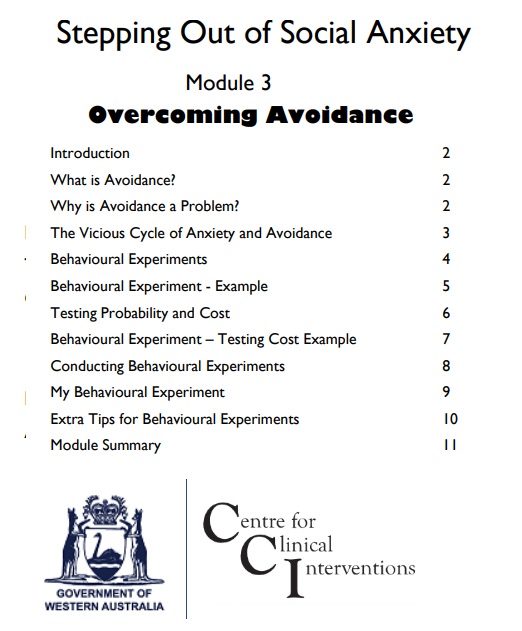
Please also see this article www.cci.health.wa.gov – Overcoming Avoidance

